The Hall of Mirrors
Why standard AI evaluation produces fragile demos. The triple blind spot: the curse of polite unit tests in memory, the headless lie that elements render cleanly, and the prototype plateau avoiding hard domain logic.
We gave two AI coding environments the exact same business assignment: build an online marketplace for buying and selling new and pre-owned gym equipment. The first agent worked without guidance and built RawExerMart. The second agent worked inside the SeikoClaw quality system and built ClawExerMart. In a five-minute status meeting, both look finished. Once you step into the shoes of a buyer spending $2,000 on a used power rack, the difference between a prototype and a real product becomes obvious.
Domain modeling rules, Apple motion standards, worst-case UI stress testing, and live Chrome verification gates.
3 basic screens: a product grid, a vendor price table, and a basic listing form. Tested only in simulated memory.
6 complete customer journeys: 8-point mechanical inspection, basement ceiling matcher, instant cash buyout, and liftgate freight.
How deterministic first principles, persistent memory, and live runtime verification transform autonomous AI coding from shallow prototypes into production systems.
When standard AI coding assistants are asked to build software, they default to the lowest-common-denominator pattern on the internet. They spin up boilerplate templates, write unit tests against polite, synthetic data, and report green checkmarks without ever looking at a rendered screen. In a five-minute status demo, the resulting software appears finished. In the hands of a real customer spending two thousand dollars on heavy equipment, the illusion collapses under the weight of broken layouts, missing domain logic, and silent edge-case failures.
SeikoClaw was engineered to end this era of conversational consensus. Instead of treating code generation as a single chat turn, SeikoClaw envelops autonomous agents in an uncompromising quality harness. Powered by 24 inviolable first principles, an OpenBrain persistent sidecar database tracking task DAGs and decision trails, pre-execution security guardrails, and deterministic skill routing, the harness forces AI to work like a seasoned principal engineer.
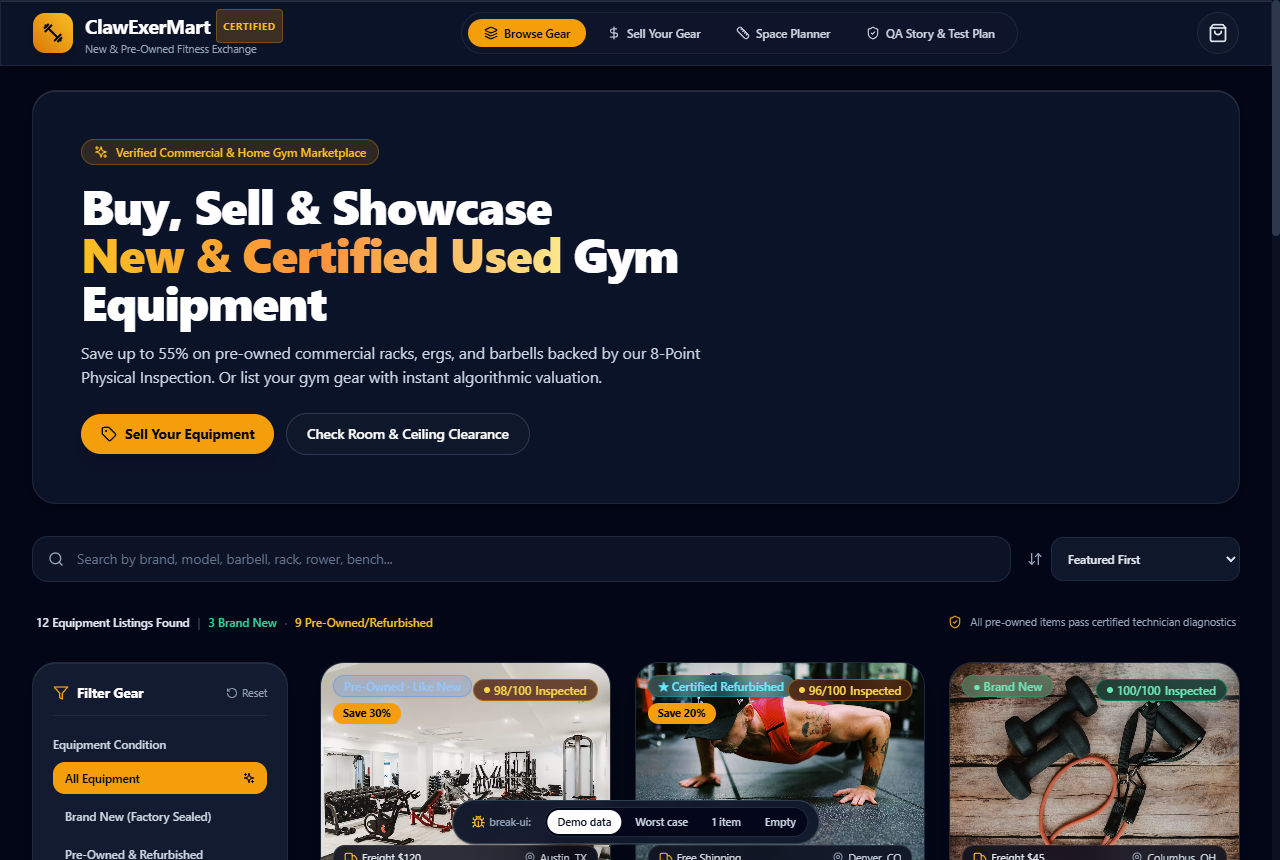
The definitive proof of this methodology is recorded in the ExerMart A/B Case Study. Given the exact same starting prompt—to build an online marketplace for commercial gym equipment—an unguided AI produced RawExerMart: three shallow screens that missed a catastrophic $129,999 pricing bug. Inside the SeikoClaw Harness, the same underlying model built ClawExerMart: six complete buyer and seller journeys, an 8-point physical inspection grading engine, an interactive basement ceiling clearance calculator, LTL freight logistics, and eight edge-case defects caught and resolved before launch through adversarial stress testing and windowed Chrome verification.
"The unit test that passes on clean dummy data is the ultimate false summit. True software quality is an empirical discipline: it demands domain reality at the seams, worst-case stress at the boundaries, and photographic proof on the glass."
Why standard AI evaluation produces fragile demos. The triple blind spot: the curse of polite unit tests in memory, the headless lie that elements render cleanly, and the prototype plateau avoiding hard domain logic.
Autonomy without structural constraints produces slop. How the 24 first principles, OpenBrain SQLite/vector sidecar, pre-execution POSIX/Windows safety hooks, and deterministic skill routing enforce principal engineering standards.
The head-to-head showdown: identical prompt given to unguided AI (RawExerMart) vs. the SeikoClaw Harness (ClawExerMart). Both passed their unit tests; only one built an application that closes sales.
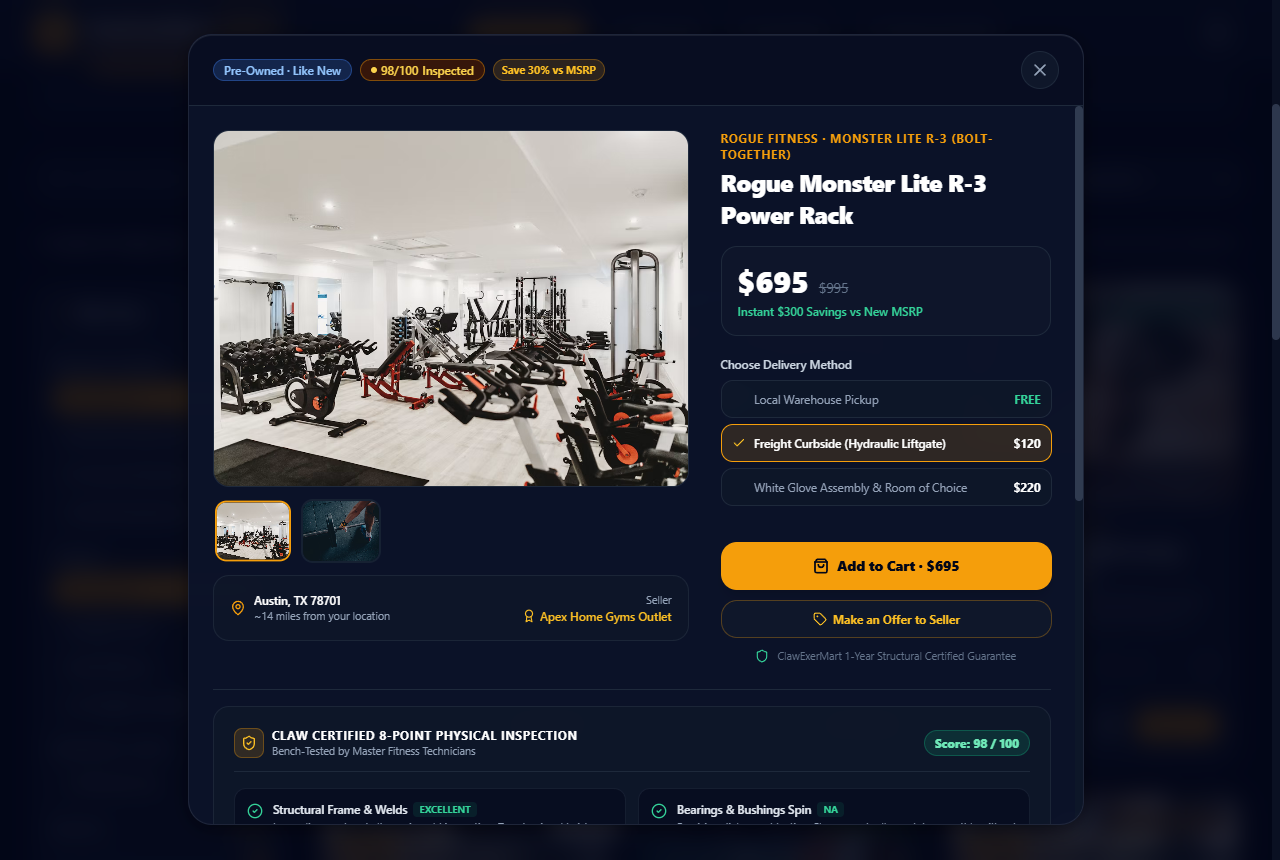
Transforming 3 basic screens into 6 complete customer journeys: an 8-point physical technician inspection sheet, 3D basement ceiling clearance calculator, brand depreciation curves, and LTL liftgate freight.
How break-ui stress testing caught the silent revenue killer: the catalog price slider capping at $5,000, hiding all high-ticket commercial gym inventory from buyers despite 40 passing unit tests.
Software runs on glass. Enforcing QA Constitution Rule #8 (Anti-Soft-Pass) with windowed Chrome Playwright verification, 7 photographic proofs, and Apple motion spring physics.
Explore the unabridged story covering the philosophy, game engine MCP bridges, and algorithmic generation.
Standard AI coding assistants excel at generating a first draft that compiles. Business risk hides in what happens next: whether buyers trust the store, whether high-value orders survive edge cases, and whether anyone actually looked at the screen.
When an unguided AI builds an online store, it copies the most common template on the web: a grid of photos, a price tag, and a filter bar. RawExerMart stops there.
Selling heavy, pre-owned gym equipment requires answering three customer objections before anyone enters a credit card:
In RawExerMart, 40 automated tests ran and passed. Every single test used polite, idealized sample data: three-word titles, four-digit prices, and working image links.
Real inventory is messy. Sellers paste 20-word product titles, upload broken photo URLs, and list $129,999 commercial gym packages. SeikoClaw forced ClawExerMart through an automated worst-case stress test before launch.
That stress test caught 8 defects, including a silent revenue killer: the price filter slider defaulted to a $5,000 cap, which hid every high-margin commercial rig ($24,995 and $129,999) from visitors on initial page load.
The biggest hidden cost in AI software is the false green light. RawExerMart reported 100% passing tests without ever opening a web browser. Its test runner only checked text in memory.
When an agent never looks at the rendered screen, visual defects ship straight to customers. Discount pills collide with inspection badges, and long city names push shipping costs off the card.
SeikoClaw refuses to mark a task complete until it launches a real Chrome window, clicks through every customer workflow, verifies zero console errors, and saves 7 photographic proofs in the repository.
| Business question | Unguided AI (RawExerMart) | With SeikoClaw (ClawExerMart) | Why leadership cares |
|---|---|---|---|
| How many customer workflows ship from one prompt? | 3 basic screens (catalog, price table, basic post form) | 6 complete buyer & seller workflows | Cuts follow-up prompting and product rework cycles in half |
| What happens when a $129,999 commercial order is listed? | Untested against extreme inventory or broken photos | Stress-tested across 8 real-world edge cases | Prevents silent filter and layout bugs on high-margin items |
| Did anyone verify the actual screen in a real browser? | 0 browser runs (simulated memory tests only) | 7 automated Chrome visual sign-offs | Stops visual collisions from reaching customers |
| Does it feel like a prototype or a commercial product? | Generic browser defaults and bouncy alerts | Tactile controls & clear visual hierarchy | Builds immediate buyer confidence on the first click |
Both applications run live below. Follow the three steps below to experience the difference in under a minute.
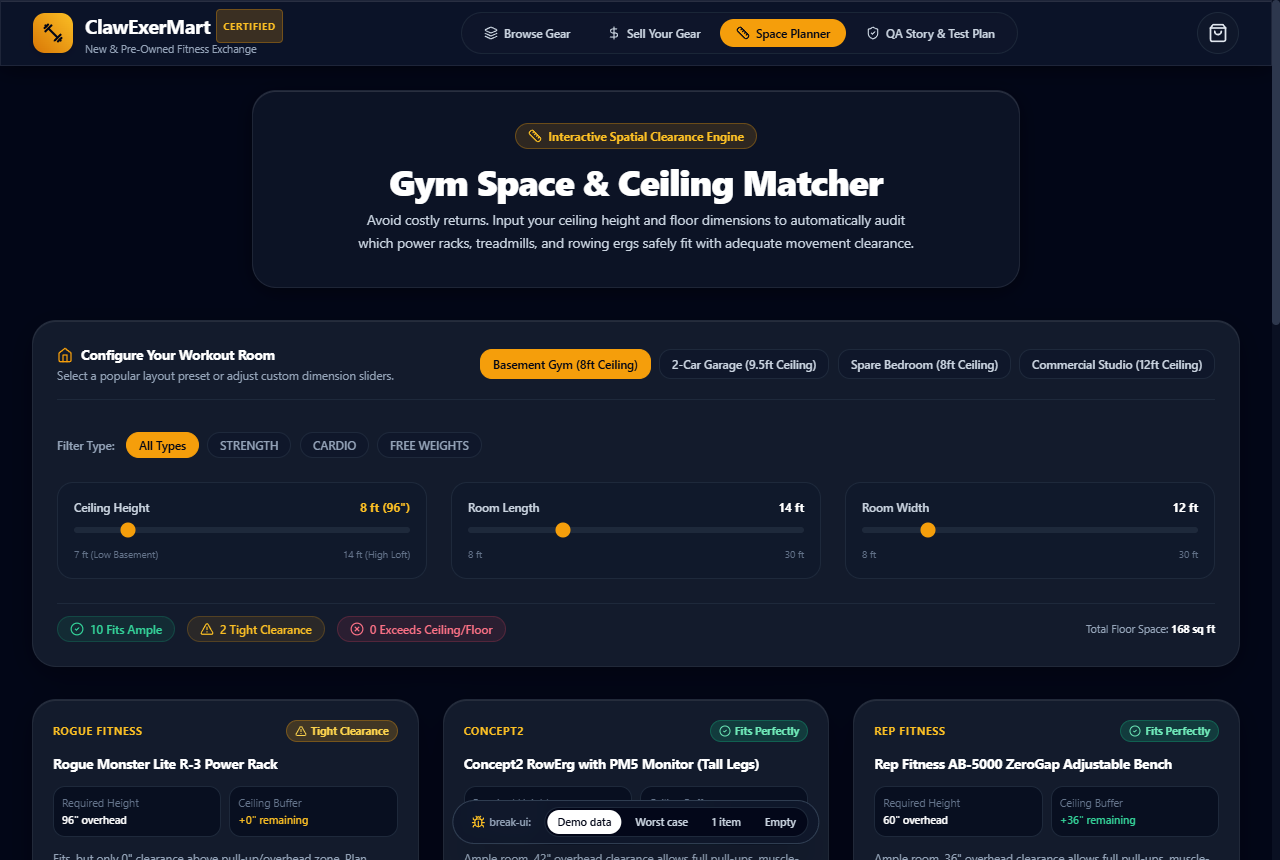
Watch ClawExerMart flag which racks will hit an 8-foot basement ceiling. Notice that RawExerMart on the left has no way to check if a machine fits your room.
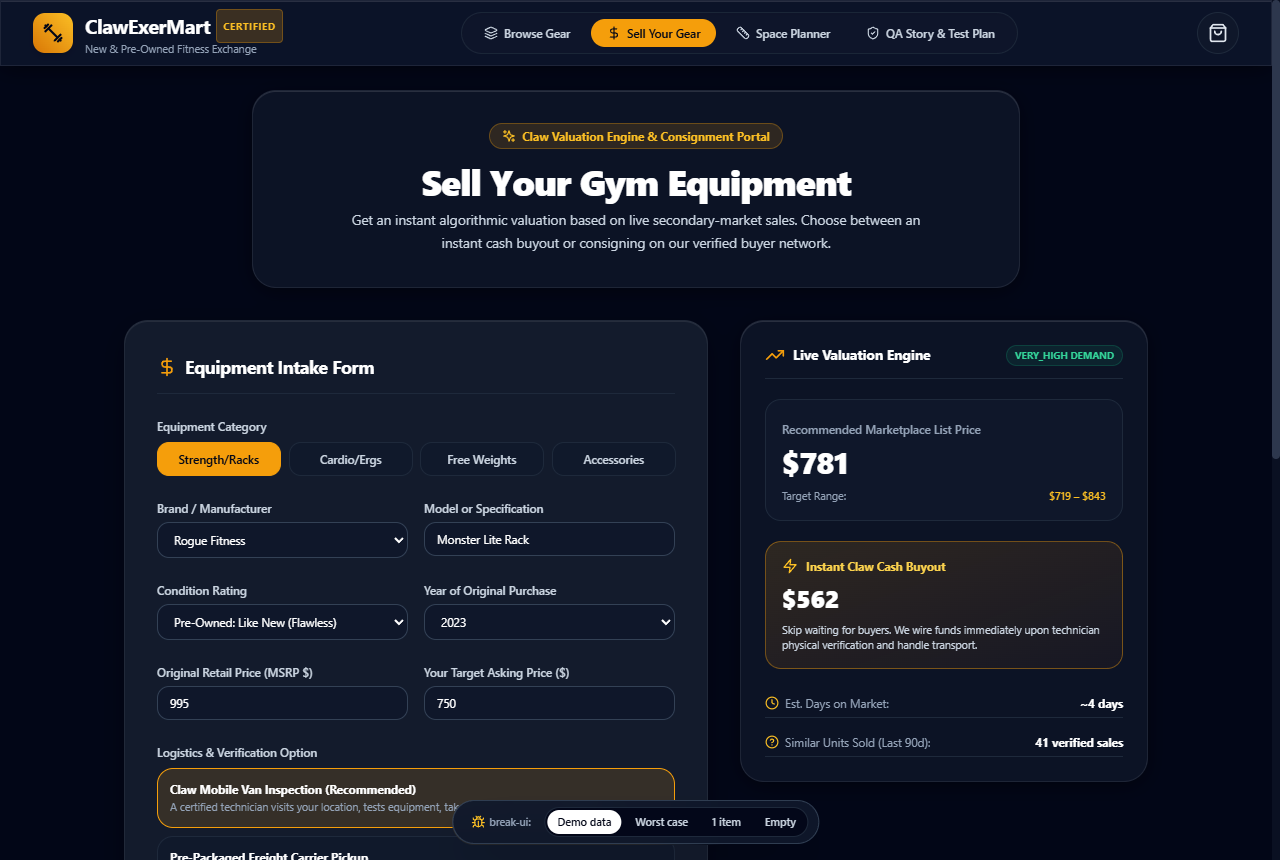
The left window gives you a blank box asking you to guess a price. The right window calculates market resale value and offers an instant cash buyout on the spot.
Feeds a 145-character title, a broken photo URL, and a $129,999 commercial package into ClawExerMart with zero overlapping buttons.
Scored against repository artifacts. RawExerMart scores higher on backend plumbing because it built an Express API, while ClawExerMart leads across customer workflows, visual craft, stress resilience, and real browser verification.
break-ui) (145-char titles, $129,999 prices, CJK/diacritics, broken image fallback, 1-item grammar)
4.0 vs 9.5 / 10
seikojin-qa) (memory-only JSDOM in Raw vs. live Chrome Playwright + 7 visual proofs in Claw)
2.0 vs 10.0 / 10
| Dimension | RawExerMart (No Harness) | ClawExerMart (With SeikoClaw Harness) | SeikoClaw skill / gate |
|---|---|---|---|
| 1. Source footprint | 27 source files (2,921 LOC across client/ and server/) |
23 source files (4,133 LOC in src/) |
architect |
| 2. Core user workflows | 3 workflows: Catalog browse/filter, 5-vendor price comparison table, and basic listing modal | 6 workflows: Catalog browse/filter, 8-point physical inspection sheet, counter-offer modal, algorithmic consignment/buyout valuation portal, room & ceiling clearance matcher, and LTL freight cart drawer | codebase-design |
| 3. Pricing & valuation math | Min/average vendor price comparison in marketplaceComparisonService.ts |
Brand retention multipliers (1.25x Eleiko, 1.20x Concept2, 1.15x Rogue), condition discount curves, annual depreciation floor, and 72% instant cash buyout offer in valuation.ts |
codebase-design |
| 4. Spatial & ceiling modeling | Static strings inside specs dictionary |
Interactive room & ceiling height clearance engine (FITS_PERFECTLY, TIGHT_CLEARANCE, EXCEEDS_CEILING) in spaceCalculator.ts |
codebase-design |
| 5. Pre-owned trust mechanics | Single conditionNotes text string |
Structured InspectionReport grading frame weld integrity, needle-bearing runout, cable tension, upholstery rebound, cardio motor hours, and oxidation check |
codebase-design |
| 6. Backend API layer | Express REST API (/api/equipment, /api/marketplaces/compare/:id) with Scenario 2 fallback |
Client-side state with CartContext and URL search parameter state (?data=worst) |
Baseline architecture |
| 7. Typography & surface craft | 25-line index.css with default Tailwind classes |
78-line index.css with -0.025em optical heading tracking, tabular-nums, and .apple-glass (backdrop-filter: blur(20px) saturate(180%) + inset top specular border) |
apple-design |
| 8. Motion & animation physics | Stock Tailwind animate-bounce on toast notification; 500ms card image hover |
.apple-press pointer scaling (scale(0.97) on cubic-bezier(0.16, 1, 0.3, 1) at 120ms), GPU-only sub-300ms transitions, and prefers-reduced-motion reset |
review-animations |
| 9. Adversarial stress testing | Tested only against short demo strings | Live BreakUiToggle (Demo data / Worst case / 1 item / Empty) testing 145-char titles, $129,999 prices, CJK/diacritics, broken image fallback, and 52-char serial hashes |
break-ui |
| 10. Automated test suite | 40 tests across 8 Vitest/Supertest suites (Unit, API Integration, RTL Journey in JSDOM) | 23 Vitest tests across 9 suites + Non-Headless Playwright Chrome E2E runner (scripts/run-e2e.mjs) |
seikojin-qa |
| 11. Real browser visual proof | 0 browser runs; 0 screenshots | 7 non-headless Chrome PNG captures committed in captures/R1..R7.png with 0 console errors |
seikojin-qa |
| 12. Code review & traceability | DEV_LOG.md + ci.yml |
task.md DAG with [E2E_CONTRACT] blocks + WORKFLOW_LOG.md with Fowler smell & motion audits + ci.yml |
code-review |
scripts/run-e2e.mjs)
Captured automatically in visible windowed Chrome against the production Vite preview bundle under the Seikojin QA [E2E_CONTRACT] gate.
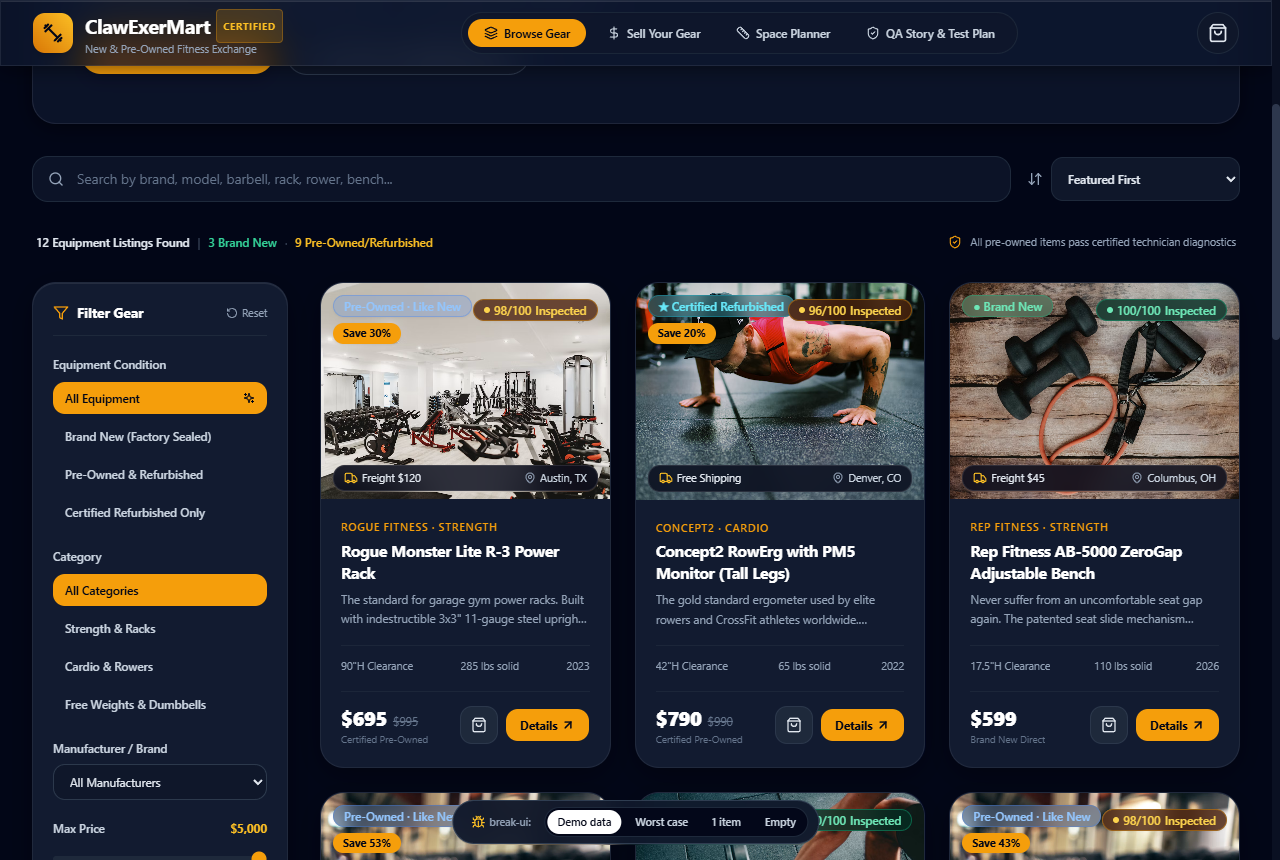
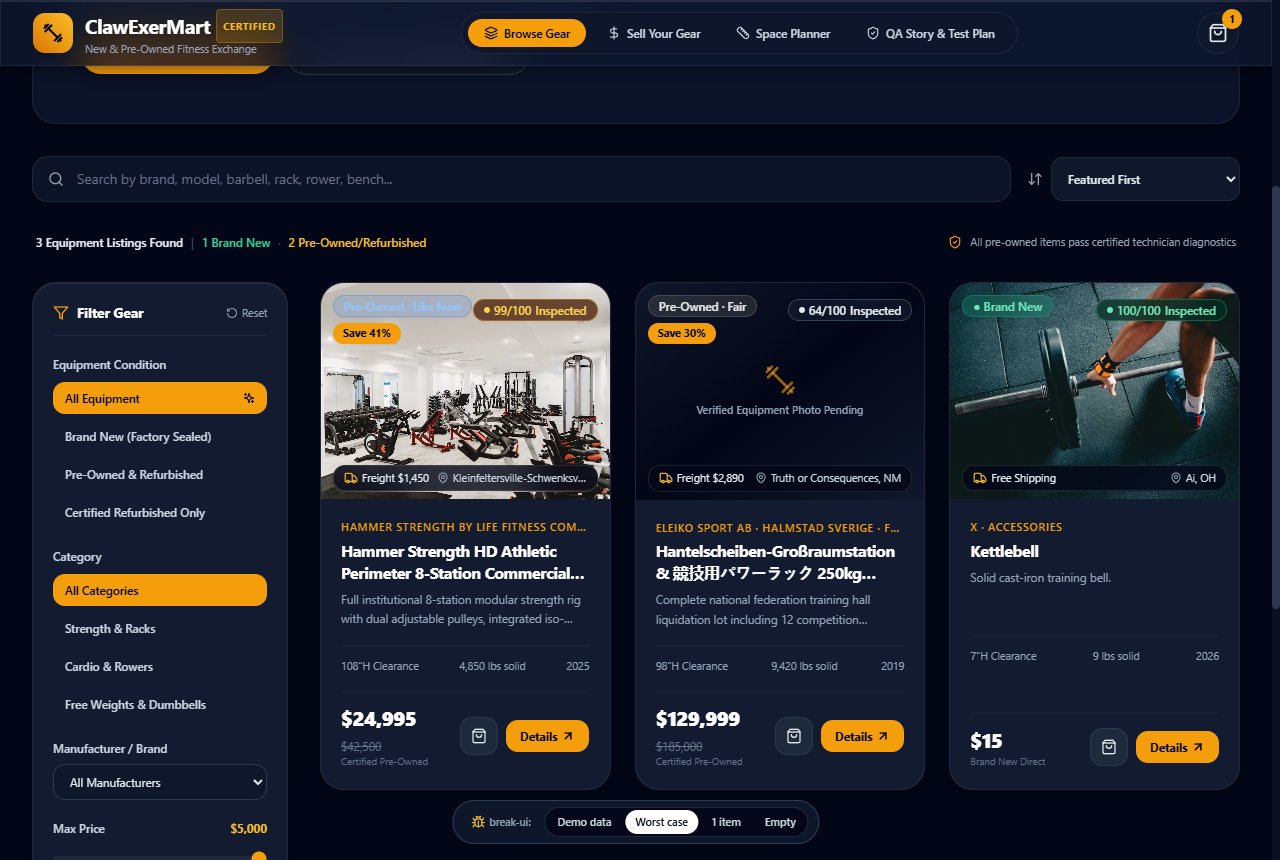
Kleinfeltersville-Schwenksville, PA), broken image fallback panel (Verified Equipment Photo Pending), German/CJK characters (Hantelscheiben-Großraumstation & 競技用パワーラック 250kg), six-figure prices ($129,999), and a minimal 1-word $15 item.
backdrop-filter: blur(20px) saturate(180%) sticky header, optical heading tracking, and bottom-center break-ui switcher.
Save 30% badge stack vertically in the top-left corner, maintaining clean separation from 98/100 Inspected on the top-right.
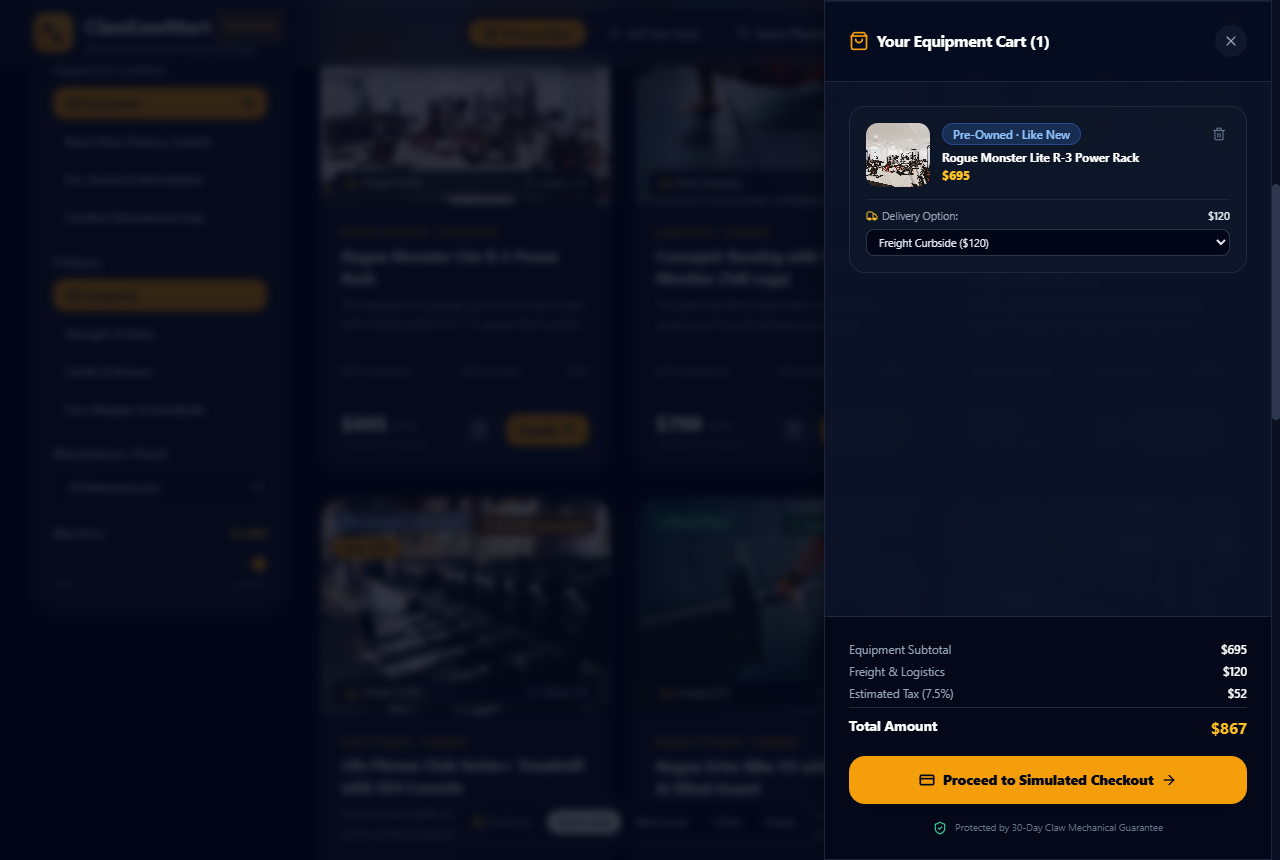
$781) and instant cash buyout ($562).
Tight Clearance: +0" remaining) vs. rowers (+42" remaining).
break-ui
Every component looks clean when tested against short demo strings. Feeding worst-case realistic data through WORST_CASE_EQUIPMENT exposed 8 bugs that were fixed and locked into src/test/BreakUi.test.tsx.
| # | Severity | Component & field | Worst-case value | What broke before fix | Fix applied |
|---|---|---|---|---|---|
| 1 | BROKEN | Catalog.tsx (maxPrice) |
$24,995 & $129,999 commercial rigs |
Slider max was 5000 ($5,000+), silently filtering out all items over $5,000 on initial page load |
Treated maxPrice === 5000 as unbounded ($5,000+) in Catalog.tsx:73 |
| 2 | UGLY | EquipmentCard.tsx (badge-savings) |
Pre-owned card with Save 30% pill |
Top-left flex-wrap row stretched horizontally into the top-right 98/100 Inspected badge |
Stacked top-left badges vertically with flex-col items-start gap-1.5 max-w-[58%] |
| 3 | BROKEN | EquipmentCard.tsx (images[0]) |
https://invalid.example.test/... |
Browser rendered broken image icon with collapsed container contrast | Added imgError state & fallback panel (Verified Equipment Photo Pending) |
| 4 | UGLY | EquipmentCard.tsx (location.city) |
Kleinfeltersville-Schwenksville, PA |
Compound city name wrapped the bottom image overlay banner onto two lines | Added min-w-0 truncate on location and flex-shrink-0 on freight cost |
| 5 | UGLY | EquipmentCard.tsx (brand) |
Hammer Strength by Life Fitness Commercial Division |
52-char brand wrapped onto 2 lines, misaligning card titles across the 3-column grid | Added truncate and full title tooltip |
| 6 | UGLY | EquipmentCard.tsx (price) |
$129,999 + $185,000 MSRP |
Six-figure price + strikethrough MSRP squished the Add to Cart and Details buttons | Added tabular-nums, min-w-0 on price column, and flex-shrink-0 on CTAs |
| 7 | UGLY | Catalog.tsx (results-count) |
1 item dataset mode |
Rendered ungrammatical "1 Equipment Listings Found" |
Added singular/plural check (1 Equipment Listing Found) |
| 8 | UGLY | ProductDetailModal.tsx (specs) |
HS-IWF-3085512-994021-SWEDEN-REV4B... |
Unbreakable 52-char serial hash overflowed the specification table column | Added min-w-0 break-all sm:break-words on dd elements |